
Santa Barbara County City Directory Collections
The best documented Santa Barbara County historical holdings are a mix of regional print, digitized telephone books, library microfilm, newspapers, and manuscript collections. The table distinguishes a free page-image run from a shelf that needs a reference request. Exact reverse or criss-cross years at the Santa Barbara Public Library should be confirmed with Reference because the public catalog is not an exhaustive shelf list.
| Collection | Years | Where Held | Access |
|---|---|---|---|
| L. L. Paulson regional handbook | 1875 | Library of Congress | Free digital item |
| Santa Barbara telephone books | 1940 to 1963, with issue gaps | Library of Congress | Page images and OCR |
| Santa Maria directories | 1922 to 1961, with issue gaps | Library of Congress | Page images and OCR |
| Santa Ynez directories | 1942 to 1962, with issue gaps | Library of Congress | Page images and OCR |
| Reverse or criss-cross volumes | Years require confirmation | Santa Barbara Public Library | Onsite reference help |
| Local newspapers and clippings | Morning Press 1872 to 1922; Weekly Press 1900 to 1913 | CDNC and local repositories | Digital or archive access |
The runs do not describe one continuous publication. A directory may be a telephone volume, a regional handbook, or an address-ordered companion. Keep the community name and issue date with every citation.
Santa Barbara County 1875 Regional Directory
The Library of Congress 1875 regional handbook is an early directory starting point for Santa Barbara County. It covers Santa Barbara together with six other southern and central California counties, so it should not be read as a complete city-only roll. Its value is historical placement: a name, business, community, or regional reference may appear before the better-known telephone runs.
The 1875 volume also illustrates why the phrase city directory needs care. A regional handbook can mix civic description, business information, and personal references. It may help identify a place or an occupation, but it will not necessarily show every household or arrange entries like a later telephone book. Use the page image and the printed title when citing it.
Santa Barbara's records story reaches even earlier through State Archives microfilm listing deeds from 1844. That pre-county material makes a directory clue more useful when paired with a deed, map, newspaper notice, or family record. It also explains why a modern search box should never be treated as the entire historical shelf.
Note: The 1875 volume is regional, so its Santa Barbara reference does not equal a complete county household roll.
Santa Barbara County 1940-1963 Directory Run
The Library of Congress digitized Santa Barbara city directory material in issue groups: January 1940 through October 1942, July 1943 through October 1946, April 1947 through September 1948, June 1949 through July 1952, July 1953 through July 1956, July 1957 through July 1959, July 1960 through July 1961, a January 1962 special issue, and July 1962 through July 1963. Page images and OCR are available through items numbered usteledirec03585 through usteledirec03593.
OCR is a finding aid, not a final transcription. Inspect the page image when a name, street, or number matters. The sample reviewed from the 1943 to 1946 volume contains a cross-reference from Spaulding to Spalding and entries with both office and residence language. A search for only one spelling can miss the relevant household.
The exact digitized issue list gives a family-history search a firm set of dates. For years outside that list, ask the library or archive rather than assume the collection has no volume.
These page images show the regional digital doorway for the collection:
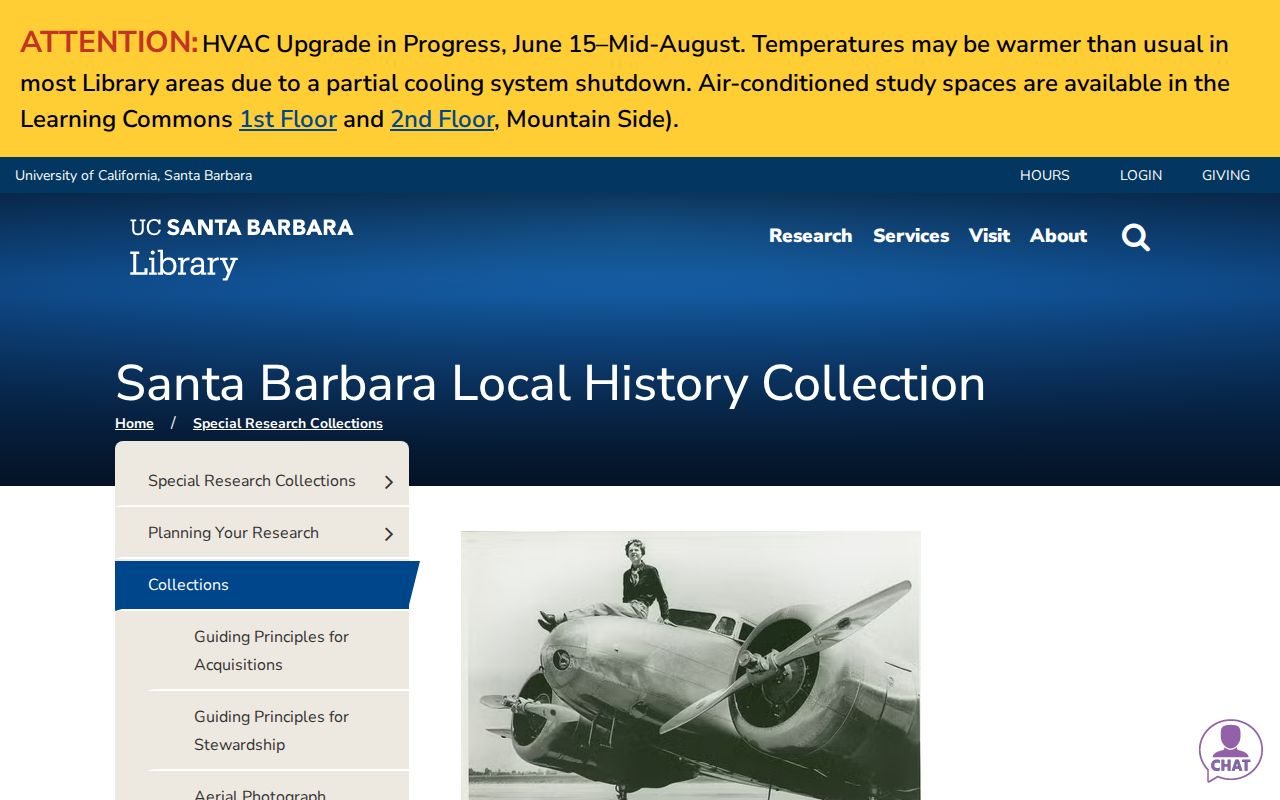
A digital page is convenient, but a page citation should still record the volume, issue, leaf or page, and the spelling printed on the image.
Note: OCR can find a page quickly, but the printed image controls spelling, ditto marks, street numbers, and abbreviations.
Santa Barbara County Town Directory Runs
Directory research in Santa Barbara County must follow the community named in the record. Library of Congress holdings include Santa Maria directories from 1922 through January 1948, September 1948 through July 1951, July 1952 through July 1957, and July 1958 through July 1961. Santa Ynez directories include January 1942 through July 1955 and July 1956 through January 1962.
These runs matter because a county search can cross valleys, rural areas, and communities with separate phone books. An entry in Santa Maria is not interchangeable with an entry in Santa Barbara. Copy the city printed on the page, then compare the address with a map, newspaper, census, or deed if the family moved.
The same rule applies to the regional handbook. A broad volume can supply a lead, while a local issue may supply the house number and residence notation. The two records answer different questions and should be cited separately.
Santa Barbara County Library Directory Desk
Santa Barbara Public Library local-history service offers free onsite Central Library microfilm and research resources to residents and visitors. Central Library is at 40 E. Anapamu Street, and the published phone is 805-962-7653. The Reference Unit can help with local-history questions, newspapers, directories, and genealogy resources.
Remote work is mail-only for the documented service. An obituary search costs $25 per person for a ten-day window around death. A local-history search costs $50 per 30 minutes. The fee is due even when no result is found, quoted turnaround is two to four weeks, and scans can be emailed when an email address is supplied. The request asks for names, dates, events, contact information, and payment by check or money order.
The library recommends the Santa Barbara Genealogical Society's updated obituary database as a quicker first check. A directory entry can then be paired with a notice, census page, or deed. These channels are complementary, not substitutes for one another.
The library access point shows where a local-history question moves when a digital search stops:
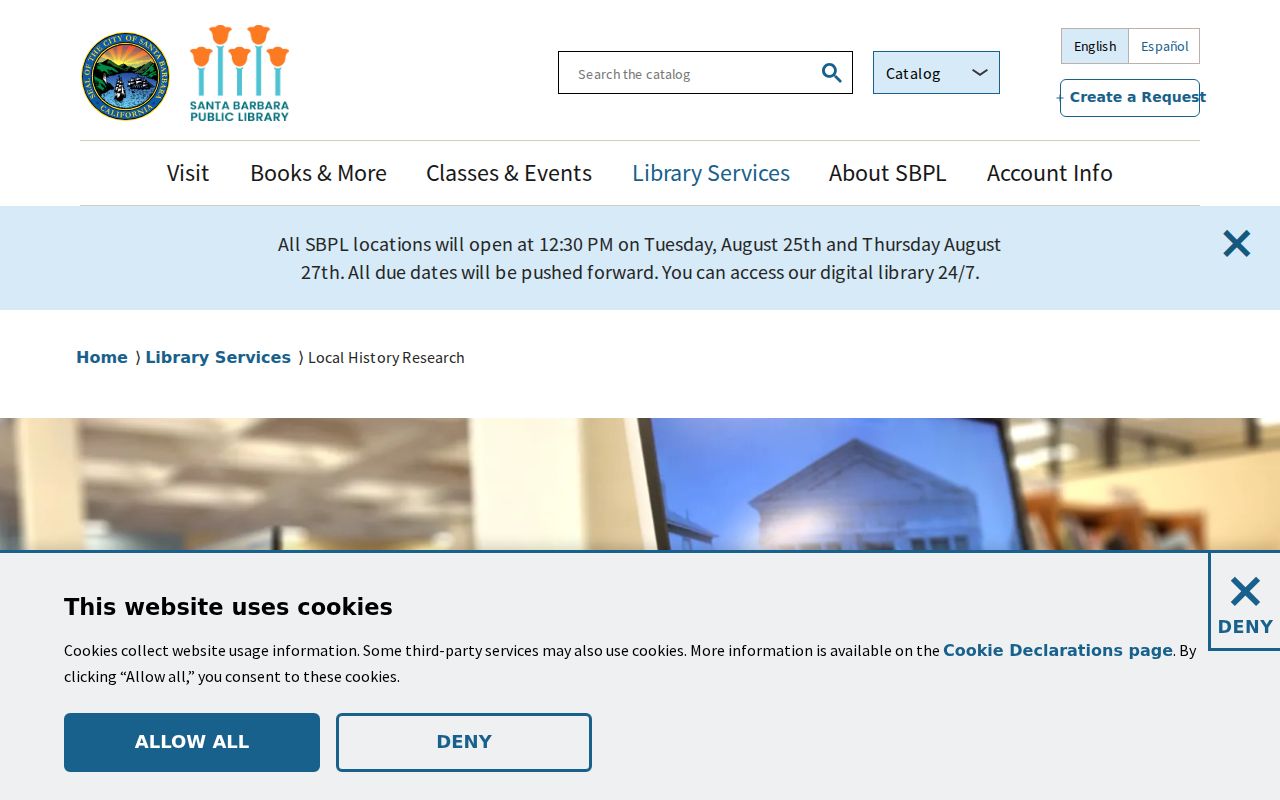
Ask Reference to confirm reverse or criss-cross shelf years. The research record does not establish an exhaustive publisher list, so certainty about a missing year should come from the keeper.
Note: Library shelf coverage varies, so the keeper should confirm a reverse or criss-cross volume before a gap is treated as fact.
Reading a Santa Barbara County City Directory
A Santa Barbara County city directory entry is compact. The 1943 to 1946 sample begins with the surname and given name or initial, then may show an honorific, occupation, office or business address, and an explicit residence marked “Residence” or “r.” Advertisements can add a business, street, phone, or residence phone. No owner or occupant-status mark was observed in the sample, so such a fact must not be inferred.
| Name | Surname followed by given name or initials, with cross-references for spelling variants. |
|---|---|
| Occupation | Profession or work description printed beside the name when supplied. |
| Office or business | A work address that may differ from the residence. |
| Residence | House number and street, sometimes marked “Residence” or “r.” |
| Phone or advertisement | May add business, person, street, or residence phone details. |
| Cross-reference | A note such as Spaulding to Spalding that changes the search spelling. |
- Criss-cross directory
- A street-order or address-order directory used to search from a place instead of a surname.
- Householder index
- An index organized around people or household heads, when a particular volume provides one.
- Abbreviation key
- The volume's explanation of short forms, often worth locating before reading entries.
- OCR
- Machine-read text that helps find a page but may misread names, ditto marks, and numbers.
Photograph or save the abbreviation key before transcribing a run. It can change the meaning of a short address or professional term.
Santa Barbara County Directory Spelling
The small quirks of a local directory often decide whether a search succeeds. In the sample leaf, “Following Name Designates Residence” appears near the alphabetic entries, and Spaulding points readers to Spalding. The page also shows that two people with the same surname can have different occupations, streets, and residence lines.
Search the printed spelling and its cross-reference. Try initials, a middle name, an abbreviated street, and a likely alternate surname. Spanish compound names, anglicized spellings, and OCR errors need the same patient approach. Surname overlap is not proof of kinship.
If a name disappears, inspect the adjacent issue and the reverse section before concluding that the household moved or a person died. A skipped issue, an unlisted phone, or a changed spelling may explain the gap.
Pair Santa Barbara County Directories and Census
Directories fill the years between decennial census releases. Start with one known name and address, then use the nearest directory issue to see whether the address, occupation, or household clue persists. Federal census pages from 1850 through 1950 are publicly released under the 72-year rule, while the 1960 census is scheduled for release in 2032. A directory issue can therefore be the bridge between two public census snapshots.
- Choose the earliest directory entry that matches the person's name and community, and record the full printed citation.
- Copy the residence notation, street number, occupation, spouse clue, and any spelling cross-reference.
- Check the closest census year for household relationship, age, birthplace, and occupation.
- Repeat the directory search forward and backward, including the reverse section when available.
- Use newspapers, obituaries, probate, deeds, or vital records to test a move, death, or family link.
A directory disappearance is a prompt for another source, not proof of a move or death. A present address in one issue is also a dated observation, not a lifetime residence.
Santa Barbara County Archive Directory Collections
The Gledhill Library holds books, pamphlets, photographs, maps, oral histories, newspapers, clippings, ephemera, manuscripts, and government records. It is public and noncirculating, with the archivist reachable at archivist@sbhistorical.org. Its material can add context when a printed directory supplies a name but not the story behind an address.
The UCSB Special Collections adds regional political, cultural, and environmental manuscripts, including the Santa Barbara History Collection. CEMA broadens the archive for African American, Asian and Pacific American, Chicano and Latino, and Native American cultural history. Mission Archive-Library research reaches mission, Franciscan, California, and Native peoples' material through about 1850.
These repositories are not open member rosters. Their value is evidence, context, and a second source for a directory lead.
The Gledhill research-library image points to the archive layer behind the printed runs:
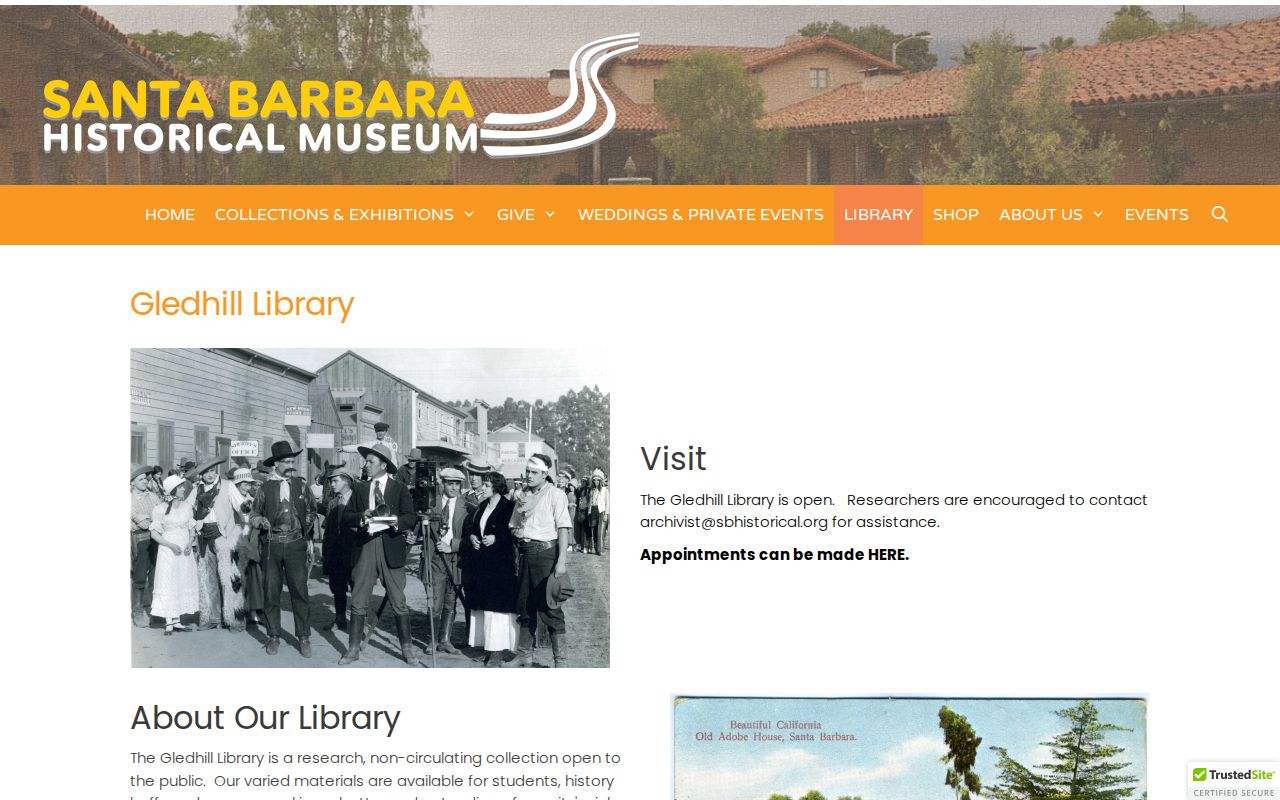
When a volume is not digitized, ask for the collection name, issue date, and access conditions. Do not fill an unverified shelf gap with a guessed publisher or year.
Using Santa Barbara County City Directories
For family history, a Santa Barbara County city directory works best as a dated sequence. The name points to an entry. The entry points to a street. The street points to a parcel, newspaper, map, or household record. The process is more reliable when the same address or relationship appears in two independent sources.
- Start with the person's full name, likely spelling variants, and a known community.
- Find the first matching directory issue and copy the entry rather than relying only on OCR text.
- Follow the name through adjacent years, noting every move, occupation change, and cross-reference.
- Pair the run with the nearest census, newspaper, obituary, probate file, deed, or vital record.
- Record uncertainty when a directory gap, common name, or missing reverse volume prevents a firm conclusion.
The historical shelf is especially useful for former residents and house history, while modern address work belongs in the Santa Barbara County street directory. A name that needs present-day verification can move to the resident lookup path without treating a decades-old directory entry as current.
Note: Pairing a directory issue with census or deed evidence helps separate a dated clue from a lasting household conclusion.