
How Santa Barbara County Residents Are Found
A useful Santa Barbara County residents directory search begins by naming the question. A current name may lead to a court index, a business filing, a professional license, or a recorded deed. An address points first to the Assessor's parcel search, then to a deed or permit trail. A family-history question belongs with city directories, newspapers, vital records, census pages, and archives. Each source describes a different relationship, so the result needs a date and a record type beside it.
There is no countywide public roll that lists every household. The Assessor does not offer an owner-name input, California My Voter Status is a self-check rather than an open directory, and protected people can be omitted. An index hit can still supply a sound next step when it is matched to a parcel, case number, filing date, or second source.
- Write down the clue exactly, including spelling, middle initial, former name, street number, or approximate year.
- Use the matching official index first. A name may belong in the recorder, court, Secretary of State, license, or custody system.
- For an address, use the Assessor lookup to capture the APN, normalized situs, map link, and legal-description clues.
- Match the clue to a second record, such as a deed, permit, obituary, directory entry, or vital certificate.
- When the needed record is not online, contact the custodian in person, by phone or mail, or through a California Public Records Act request.
The chain keeps the county search useful without turning a partial record into a claim about where someone lives today.
Santa Barbara County Resident Records Offices
The records desk for Santa Barbara County is spread across offices with different custodial roles. The Clerk-Recorder holds deeds, maps, public marriages, vital certificates, fictitious business names, and other filings. The Assessor turns a situs address into a parcel identifier. Elections handles self-status and restricted voter-file requests. The Superior Court keeps trial case indexes and files. That division is the first safeguard against searching the wrong database.
Santa Barbara County Clerk-Recorder
South County service in Santa Barbara
North County service in Santa Maria
805-568-2250
Santa Barbara County Assessor
Parcel Details and Value Notice Lookup
Search by situs address or APN
Owner-name search is not offered
Santa Barbara County Elections
4440-A Calle Real, Santa Barbara
511 E. Lakeside Pkwy, Santa Maria
805-568-2200
Santa Barbara Superior Court
118 E. Figueroa St., Santa Barbara
North records service in Santa Maria
805-882-4778
The Clerk-Recorder's online selector, historical index, lobby counters, copy-order form, and archive holdings form one route rather than four unrelated offices. South and north service points matter when a scan cannot be displayed remotely. Call before travel for the exact location of an older book or image.
Note: Office coverage can overlap, but the custodian determines whether a name, address, image, or certified copy is released.
Santa Barbara County Residents by Name
A name search is strongest when it identifies a record relationship, not when it promises a current residence. The Clerk-Recorder's name mode uses last name and first name syntax, recording dates, and optional advanced name searching. The Superior Court index adds party type, case type, caption, filing date, and case number. California's business and license systems can show an agent, registrant, or professional address. Each address may be a service location, mailing point, or business site rather than a home.
Use California bizfile Online search for an entity name or number, then compare registration date, jurisdiction, status, and filing history. The basic search needs at least three name characters and defaults to active entities. The advanced search can add starts-with logic, inactive status, and entity type. For a credential, California Department of Consumer Affairs license search supports board, license type, license number, business, first and last name, and registry paths.
The two public interfaces show why a county directory is a verification path. A business address may identify an affiliation, while a court party may identify a role in a case. Neither fact, alone, proves that a person occupies the address.
These captured screens show the official state routes behind a name-based resident search:
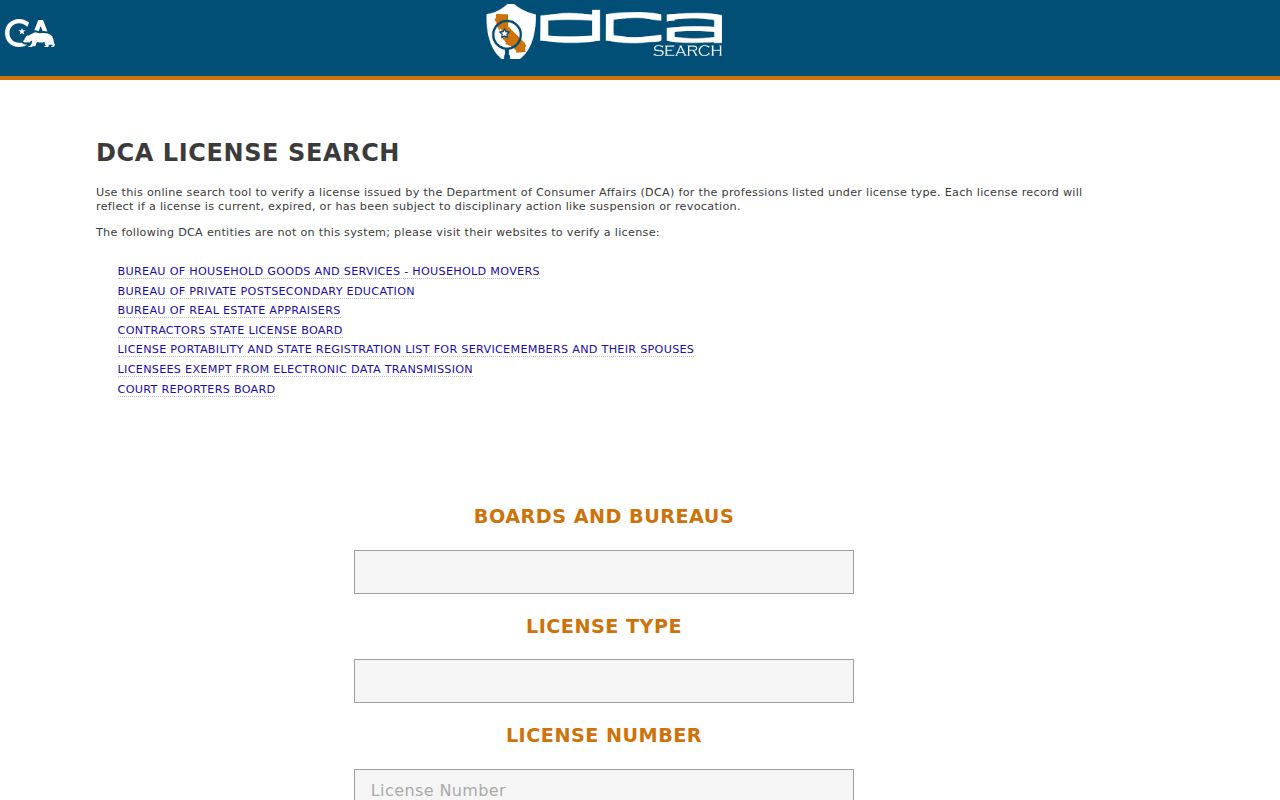
The license result is a professional record, so its issue, expiration, and discipline dates should be kept with the name variant used. A second result from a county or court custodian gives the clue a more local anchor.
The Secretary of State business index offers a similar trail for companies and agents. Its free public index can lead to filings, while some certificates and orders require an account or payment. Search the legal name, former spelling, and punctuation variants before treating a result as a match.
Santa Barbara County Residents by Address
For an address-led Santa Barbara County residents directory search, begin with the Parcel Details and Value Notice Lookup. It accepts a parcel number or a house number plus street name. The form recommends the base street name without Street, Avenue, or Boulevard, and it can sort results by parcel number or street. The result can expose a normalized situs, APN, value-notice link, and assessor-map link. A map is informational, not a legal document.
| Parcel Number | One search key, displayed in an APN format such as 123-456-789. |
|---|---|
| House Number | Used with the street name; a partial base name can broaden a search. |
| Unit # | Optional field for a unit or suite. |
| Street Name | Base name without the suffix, such as Street or Avenue. |
| Sort Results By | Parcel number by default, or Street for a street-by-street review. |
| Parcel Book/Page | Map-mode control using county book and page formatting. |
| View Assessor Map | Opens the reference map tied to the result. |
The APN then connects the address to the county GIS layer, recorded maps, permits, tax account, or a deed search. The recorder index is name-driven, so the address result usually supplies the owner name or legal clue needed for the next search. A tax mailing address is only the destination for correspondence. It may belong to a trust, manager, business, or another property and does not prove residence.
- Parcel
- A mapped unit used by the Assessor to identify land and value data.
- Situs address
- The physical location of land, distinct from a mailing address.
- Index
- A finding aid that points to a record; it is not the full record image.
- Roll
- A custodian's organized list, such as an assessment or voter file, with its own access rules.
- Criss-cross directory
- A historical directory arranged by address or street rather than only by surname.
Note: An APN connects land records, yet a parcel clue remains different from proof that a person occupies the situs.
Current Santa Barbara County Residents Directory
Current sources in a county records search are better understood as separate evidence sets. The property roll follows parcels and values. The deed index follows parties to recorded instruments. The voter system verifies a person's own status or releases approved fields for a permitted purpose. Permits add project history. A city staff directory or meeting packet identifies people in official roles, not every household.
| Source | What It May Show | Keeper | Access |
|---|---|---|---|
| Parcel and value record | APN, situs, map, assessment and value notice | County Assessor | Free address or APN lookup |
| Recorded deed index | Grantor, grantee, instrument and recording date | Clerk-Recorder | Free index, paid copies |
| Voter status or file | Self-status, precinct, or approved fields | County Elections and California SOS | Restricted by purpose |
| Permit record | Project parties, site address, dates and status | County or city Accela | Anonymous search for published records |
| Official role record | Staff, board, commission or meeting participant | City clerk or agency | Public record when published |
When the question is one named person, move from the broad source list to a one-person lookup. When the question is every parcel on a road, use the Santa Barbara County street directory route. The distinction keeps a current directory from implying that every occupant, household member, or protected voter appears in an official roll.
Santa Barbara County Voter Data Limits
California My Voter Status is a self-verification form. It returns the person who supplies the identifying data to that service, along with status, party, districts, and election information. It does not provide a public name search for Santa Barbara County residents. The county Elections page describes a separate application path for approved election, scholarly, journalistic, political, or governmental uses.
Elections Code sections 2188 and 2194, related regulations, and security rules limit the released fields and uses. A request can ask for active or inactive records, geography, history, or district data, but the applicant must state a purpose, users, safeguards, fields, and geography. The state does not accept an emailed or faxed voter-file application. Confidential voters are omitted from county-prepared lists and indexes.
Voting history can show an election date, election type, and voting method. It never shows a ballot choice. Status can later become inactive or cancelled through address confirmation and maintenance, so a voter record is dated evidence, not conclusive current occupancy.
Santa Barbara County Court Records for Residents
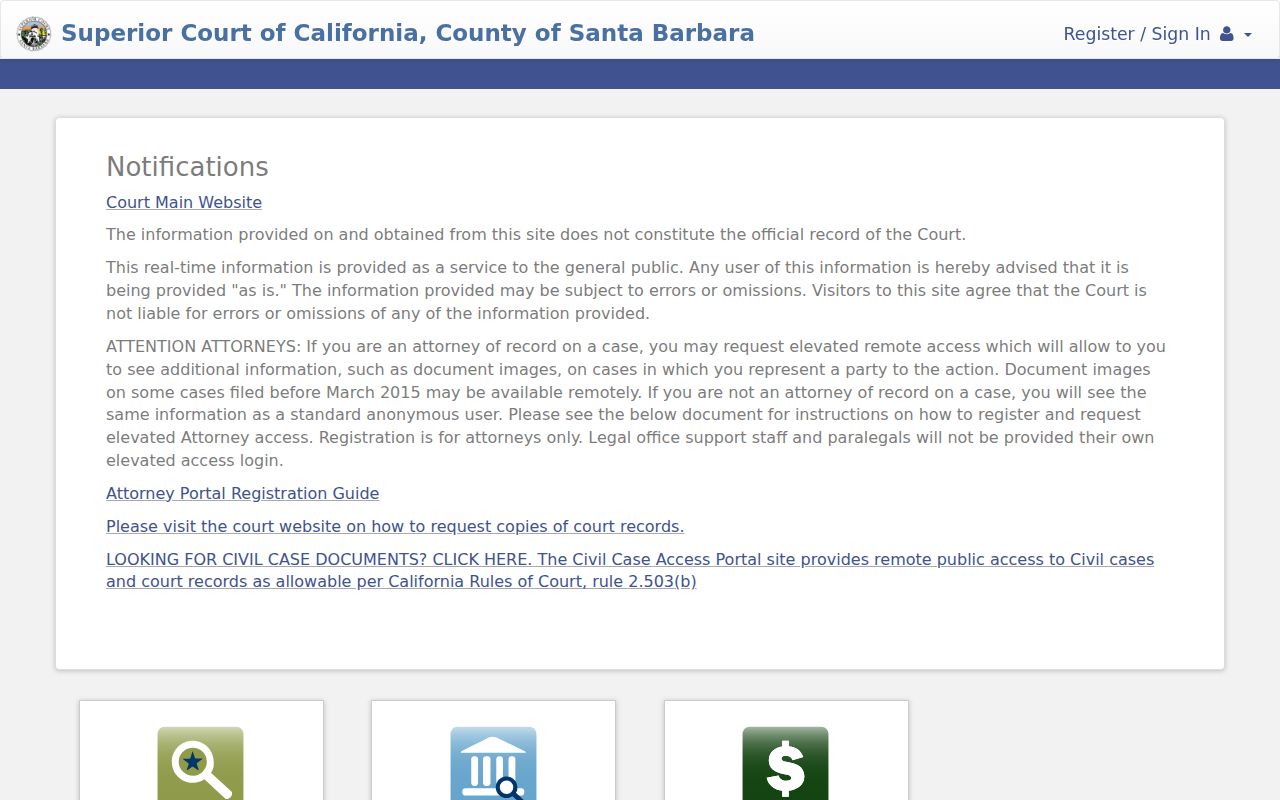
The Santa Barbara Superior Court Smart Search begins with a usage agreement. After selecting “Yes, I have read and understand the usage agreement,” the user clicks Continue and reaches the public case index. The index is informational, may contain errors or omissions, and cannot be treated as the official file. A former Superior and Municipal Court structure means one person or business can have several case numbers, so compare party role, caption, filing date, and case type.
The court's public index layouts identify last and business names, first and middle names, suffix, party type, case number, caption, file date, case type, and filing category. A clerk terminal can show lawful material that remote display rules keep off the web. South County records service is at 118 E. Figueroa Street in Santa Barbara, with public terminals on weekdays from 8 to 3. North County service uses the Miller and Lompoc lobbies. Copies, certification, mail requests, and off-site files follow court fee and timing rules.
The court portal image is useful for recognizing the official entry point before a name search:
Custody searches are separate. The Santa Barbara County Sheriff custody lookup covers current county custody and can show a name, age, CID, physical description, next court date, bail, facility, and status. The CDCR locator covers the state-prison population. The federal PACER Case Locator covers federal cases, not county jail. These systems do not overlap.
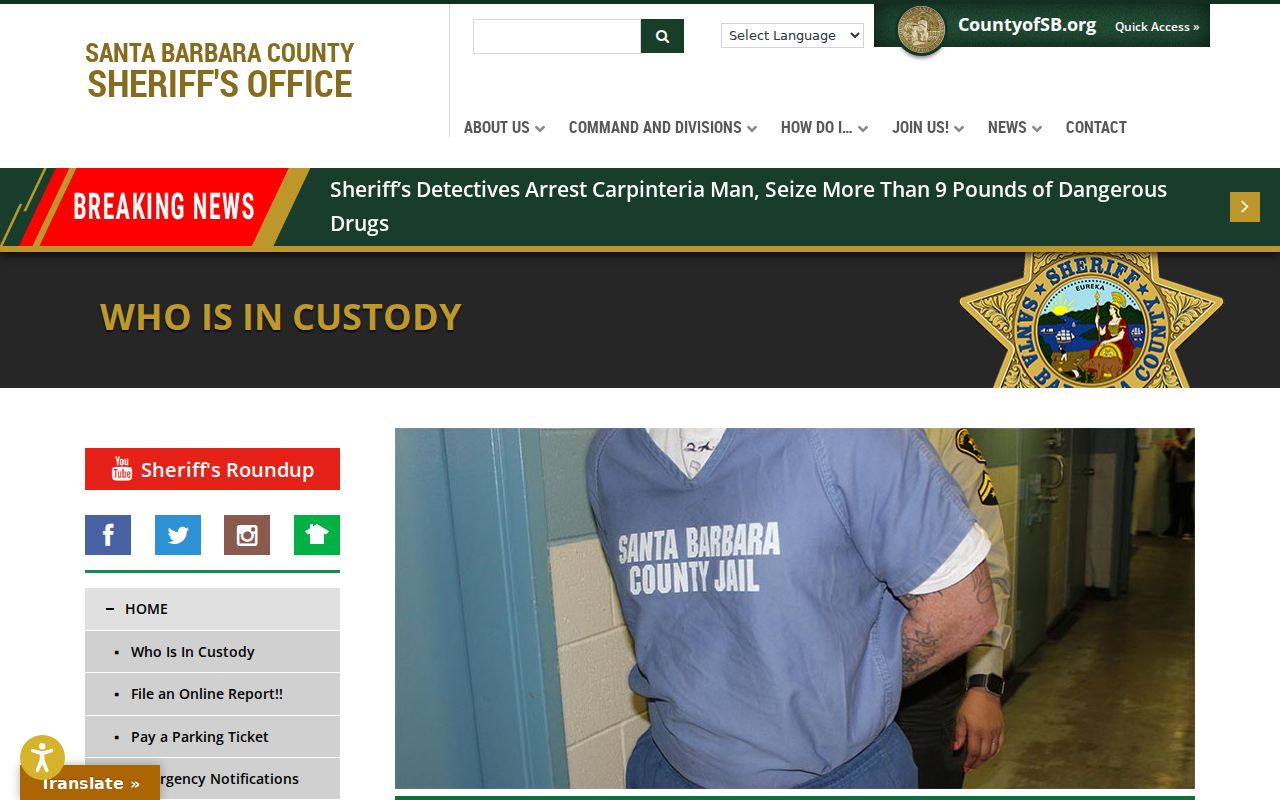
Keep the system's scope beside every result. A court name hit is not proof of a current address, and an absence from one custody locator says nothing about another system.
Note: A court or custody hit answers only the system's stated question and should be checked against its date, scope, and record status.
Santa Barbara County Vital Records for Residents
The Santa Barbara County Clerk-Recorder reports local birth, death, and marriage records from 1850 to the present when the event meets the county's jurisdiction rules. A county birth or death event must have occurred in the county. Marriage coverage follows a license issued there. Divorce and dissolution files belong to the Superior Court, not the Clerk-Recorder. The California Department of Public Health Vital Records provides a statewide route, with birth coverage beginning in July 1905.
- Birth
- County local events from 1850; CDPH from July 1905; authorized or informational certified copy; $31 state fee.
- Death
- County local events from 1850; statewide CDPH option; informational or authorized copy; $26 state fee.
- Public marriage
- County licenses from 1850; statewide option; authorized or informational copy; $19 state fee.
- Confidential marriage
- Licensing county; party to the record or court order; verify the county fee.
- Divorce
- Santa Barbara Superior Court file; public portions follow court access rules; $18 state certificate.
California uses authorized and informational certified copies rather than a simple “open after 100 years” rule. An authorized copy requires a qualifying relationship and, for mailed applications, a notarized sworn statement. An informational copy is more broadly available but is marked as not valid to establish identity and may be redacted. Sealed adoption birth records and confidential marriage records have separate limits.
The Santa Barbara County CPRA Fallback
When a portal does not publish an existing record, the California Public Records Act, Government Code sections 7920.000 through 7931.000, supplies a request path when the act applies. A request should identify the record, not ask the agency to answer a research question or create a new compilation. Name the department that made or keeps the record, give a date span, APN, document series, case number, or other useful identifier, and ask for electronic copies when available.
Under Government Code section 7922.535, an agency normally determines whether a request seeks disclosable records within 10 calendar days. An unusual-circumstances extension can add up to 14 days. That is a determination window, not a promise that production is complete. Fees generally stay within direct duplication or an authorized statutory charge under section 7922.575. Exempt material can be withheld or redacted.
- Identify the custodian, such as Clerk-Recorder, Assessor, Elections, a city department, or the court clerk.
- Describe an existing record with names, APN, dates, document type, address, or case number.
- State the preferred format and ask the custodian to identify any withheld or redacted portion.
- Use the online route when available, then preserve the request number and response dates.
- If no online route exists, use the counter, phone, mail form, library, or archive fallback documented for that record.
For older deeds, the Clerk-Recorder's copy-order form and lobby service are more useful than repeating a modern web search. Libraries, State Archives, and historical repositories bridge directory, newspaper, map, and photograph gaps.
Historical Santa Barbara County Residents Directory
The historical side of a Santa Barbara County residents directory rests on several collections. The Library of Congress holds a 1875 regional handbook covering Santa Barbara and six other southern and central California counties. Digitized Santa Barbara telephone and city directories run through specific issues from January 1940 into July 1963, while Santa Maria and Santa Ynez have their own runs. The local library offers microfilm and local-history help; the Gledhill Library and UCSB Santa Barbara History Collection add manuscripts, maps, newspapers, and photographs.
A 1940s directory entry can pair a surname with an occupation, office or business address, an explicit residence, and sometimes a phone number. Spelling cross-references matter. The sample reviewed for Santa Barbara sends “Spaulding” to “Spalding,” so a single spelling can hide the next household clue. A full collection map, year list, and reading method are available in the Santa Barbara County city directory collections page.
Directory evidence places a person or household in a publication year. It does not prove ownership, later residence, or a reason for disappearance. Pair an entry with a deed, census, obituary, or vital record before drawing a family-history conclusion.
Santa Barbara County's 1875 Records Story
Santa Barbara County's record trail reaches farther back than its modern web labels suggest. California State Archives microfilm lists Santa Barbara deeds from 1844, before the county's 1850 organization. That is a useful local story because it shifts attention from a portal's first result to the legal description and predecessor land system behind the record.
The County Clerk-Recorder's holdings and maps reach 1850, the modern recorder notice reports an index from January 1, 1900, and the historical grantor-grantee project covers 1931 through 1975. The dates describe different finding paths, not a claim that material vanished between them. A county map book, archive citation, or old directory can carry a search across the gap.
| 1844 | State Archives microfilm lists Santa Barbara deed material. |
|---|---|
| 1850 | Santa Barbara becomes one of California's original counties; local holdings and maps reach this era. |
| 1875 | L. L. Paulson's regional handbook supplies an early directory starting point. |
| 1931 to 1975 | County historical index books provide scanned grantor and grantee browsing. |
| 1900 to present | Modern recorder indexing is the current web path, subject to index limits. |
No authoritative courthouse-loss account or absolute first city-only directory was located. The safer approach is to name the known collection and its access path, then ask the keeper about the missing year.
Note: A directory entry places a name in a publication year, while a deed, census, or vital record supplies a different kind of evidence.
Verify a Santa Barbara County Name Match
Names are clues, not conclusions. Search surname-only first when the recorder's historical OCR may use ditto marks. Repeat the search with first, middle, former, business, Spanish compound, and punctuation variants. In court results, compare party type, caption, filing date, case type, and all candidate case numbers. In directories, look at occupation, address, spouse notation, and the next year. In a deed trail, verify APN and legal description at each step.
Why does one name hit need a second record? A recorded agent may use a service address, an owner may receive mail elsewhere, and a business name may belong to several people. A court index is an informational finding aid. A voter status result belongs to the person who supplied the identity details. A second record supplies the date and relationship needed to tell similar names apart.
For a family question, pair an obituary or probate file with a death or vital record. For an old classmate, use yearbooks and library archives. For an heir, use the court's probate index and accessible file while respecting sealed material. The one-person workflow keeps these checks together without rebuilding the street or historical-directory work.
Santa Barbara County Protected Addresses
Some residents will not appear in a public address trail by design. California DMV residence addresses are confidential under Vehicle Code section 1808.21. Voter identifiers and addresses are restricted. Safe at Home offers a substitute address and mail-forwarding service for qualifying victims and certain threatened public-service groups. County confidential voter registration keeps a qualifying residence address out of a county-prepared list, roster, or index.
California's Delete Request and Opt-out Platform, known as DROP, began consumer enrollment in January 2026, and registered data brokers begin processing requests on August 1, 2026. Use the Attorney General's data-broker and DROP information rather than a link in an unsolicited message. A broker deletion does not correct the originating county or court record.
The strongest result is precise about what a record shows, what it does not show, and which custodian can verify it.